How to build a simple budget you can actually use
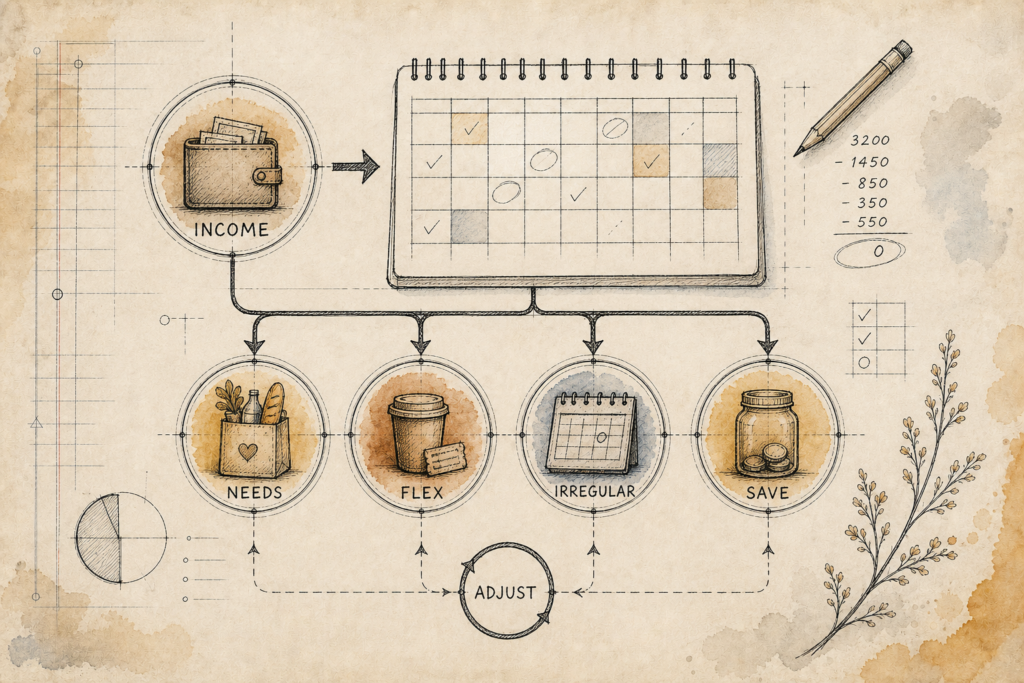
A useful budget is not a punishment and it is not a test of discipline. It is a plan for money that reflects real life. If your first version is wrong, that does not mean you failed; it means the plan learned something.
The simplest budget answers three questions: What money is likely to come in? What must it cover? What do you want the remaining money to do?
Start with money you can actually use
Write down the income that reaches your household after normal deductions. Include salaries, wages, grants, maintenance, side income and other regular sources that are reasonably dependable.
If income varies, avoid building the plan around your best month. Use a cautious figure based on a lower, normal month. You can make a separate rule for extra income, such as putting part towards an irregular expense, a debt or a savings goal.
Look at a real month before guessing
Use recent bank statements, receipts, cash notes and account histories to see where money has gone. One month is a start; several months reveal irregular costs more clearly. You are looking for information, not evidence against yourself.
Group expenses into a few practical buckets:
- Essential commitments: housing, basic food, electricity, transport, school needs and required repayments.
- Flexible essentials: costs you need but can sometimes adjust, such as groceries, mobile data or fuel.
- Irregular costs: annual fees, repairs, medical gaps, family events, clothing or seasonal travel.
- Choices and enjoyment: takeaways, entertainment, hobbies and other spending that makes life feel like life.
- Future money: savings, planned debt reduction and money set aside for a goal.
These labels are not universal. The best categories are the ones that help you decide something.
Build the first version
Subtract planned expenses from expected income. If there is money left, give it a job before the month spends it for you. If the result is negative, the budget has shown a gap that already existed. It did not create the problem.
Work through the gap in an order that protects the basics. Check for timing errors or duplicate costs. Review flexible categories. Ask whether an irregular cost can be spread across several months. Then consider which bigger commitment may need a longer-term change. A tiny cut across every category is not always as useful as one meaningful decision.
Make irregular expenses monthly
A cost does not become a surprise simply because it is not monthly. If a known annual or seasonal expense is roughly R2,400, setting aside about R200 a month turns it into a planned cost. The exact amount can change when the real bill changes.
You can keep a short “not every month” list beside the budget. Review it before school terms, holidays, insurance renewals or vehicle-service periods. This is often where a budget becomes calmer.
Use separate spaces for separate jobs
Some people find it easier to separate bill money, everyday spending and savings into different accounts or labelled pockets. Others use one account and a spreadsheet, notebook or app. The tool matters less than being able to tell what is still available.
Be careful not to create extra banking fees for a complicated system. A good method should make the plan easier to follow, not more expensive to maintain.
Check the budget once a week
A monthly plan is easier to steer with a short weekly check. Look at the balance, upcoming payments and flexible spending. Ask: What changed? What still needs to be paid? Do I need to move money between categories?
This check is not about inspecting every coffee. It is about catching a problem while there is still time to respond. Ten calm minutes can prevent the last week of the month from becoming a mystery.
A simple example
Suppose Thandi expects R18,000 of usable income. Her essential commitments are R11,500, flexible essentials are planned at R3,000, irregular-cost savings are R1,000, and other choices receive R1,200. That leaves R1,300 for a savings goal or extra debt repayment.
During the month, transport costs rise by R400. She can reduce the goal contribution, adjust another flexible category or use part of an existing buffer. The budget has not failed. It has made the trade-off visible before the money disappears.
When the numbers are very tight
Sometimes there is no comfortable version of the current numbers. Avoid blaming yourself for a gap that cannot be solved by cutting small items. Focus on protecting essential needs, communicating early about obligations, checking whether support is available, and working on the larger income or cost problem over time.
A budget cannot create money, but it can help you decide which problem needs attention first.
Takeaway
Use real income, real spending and a small number of useful categories. Plan for irregular costs, give leftover money a job, and review the plan weekly. A budget you adjust is more valuable than a perfect budget you stop using.
If borrowing is part of the picture, continue with Debt & Credit.