Everyday banking in South Africa: fees, accounts and questions to ask
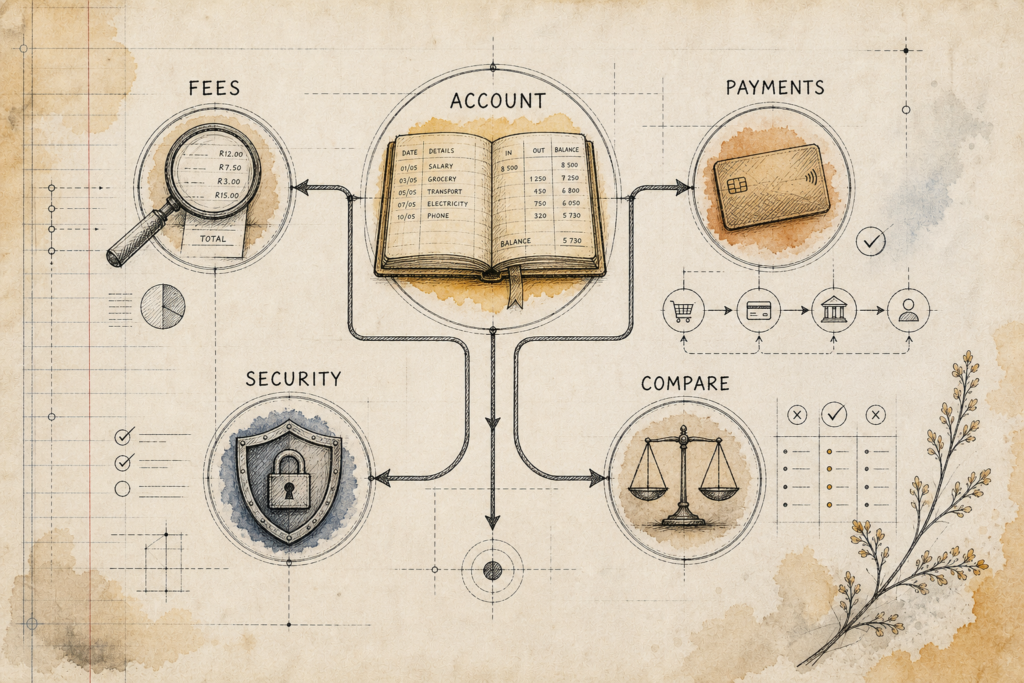
A bank account is not only a place where money sits. It is a bundle of ways to receive, store, move and access money, each with possible costs and limits. The best comparison starts with how you actually use money, not with a single headline fee or a reward advertised on a billboard.
Start with the job the account must do
List your normal month. Do you receive a salary or several smaller payments? Do you withdraw cash often? Pay by card? Buy prepaid services? Send money to family? Use debit orders? Deposit cash from a small business? Travel where mobile data or signal can be unreliable?
An account that looks cheap for a digital-only user may be expensive for someone who needs cash deposits and withdrawals. Another may include transactions you rarely use. Your pattern matters more than the label on the account.
Compare the full fee pattern
Banking costs can include a monthly account fee and separate charges for transactions or services. Depending on the account, you may encounter costs for cash withdrawals, cash deposits, immediate payments, debit orders, replacement cards, printed statements or activity outside a bundle.
Fee structures change, so use the current pricing guide from each provider. Build a sample month using your own likely activity. Ten low-cost transactions can matter more than one attractive monthly fee.
For example, Sibusiso mostly pays by card but withdraws cash twice, sends three payments and buys prepaid electricity each month. He should price that pattern across the accounts he is considering. Someone paid in cash may need a completely different comparison.
Know what kind of account you are comparing
Everyday transaction accounts are built for frequent payments and access. Savings accounts are generally designed to hold money, but access rules, rates and fees differ. Credit facilities allow borrowing and create repayment costs. A product can combine features, so read what each part does instead of relying on a familiar name.
If an account pays interest, ask how the rate works, whether it changes with the balance, how quickly you can access the money and which fees could reduce the benefit. A higher advertised rate is not the only question.
Access and reliability are part of the value
Consider how you will bank when something goes wrong. Can you block a card quickly? Is help available through a channel you can use? What happens if you lose your phone, forget a PIN or need cash where your usual network is unavailable?
Also look at nearby ATMs or cash points, branch access if you need it, app data use, device requirements, notification options and payment limits. A feature is useful only if it works in your normal environment.
Debit orders deserve attention
A debit order allows an agreed payment to be collected from your account. Keep a list of expected debit orders, their normal amounts and dates. Check statements so that you notice duplicates, unexpected changes or payments you do not recognise.
Make sure enough money is available when legitimate commitments are due. If a charge is unfamiliar, investigate through the bank’s official channel and the service provider rather than ignoring it or sharing account access with someone offering to “fix” it.
Treat security as an everyday habit
Use a strong screen lock and protect banking credentials. Do not share passwords, PINs or one-time codes. Be suspicious of messages that create panic and push you to follow a link, install an app, move money to a “safe” account or approve a notification you did not start.
If contacted unexpectedly, stop and use a trusted number or the bank’s official app to verify the request. A caller knowing your name or part of your account information does not prove that the call is genuine.
Questions to ask before opening or switching
- What would my normal month cost using the current pricing guide?
- Which transactions are included, and what happens after a limit?
- How much do the cash services I actually use cost?
- What are the payment, withdrawal and transfer limits?
- How do I get help, block access or replace a card?
- What documents or minimum activity does the account require?
- How do I close or change the account, and are any linked services affected?
Review the statement, not just the advert
After opening an account, review two or three real statements. Compare actual fees with what you expected. Cancel services you do not use, adjust transaction habits where practical, and compare again when pricing or your circumstances change.
Rewards can be useful, but include the effort, conditions and extra spending required to earn them. A reward is not a saving if it encourages spending you would not otherwise choose.
Takeaway
Choose the questions before the bank. Map how you receive and use money, calculate a realistic monthly fee pattern, check access and support, and protect your credentials. The right account is the one whose costs and features make sense for your life—not the one with the loudest promise.
Explore more in Banking & Everyday Money.